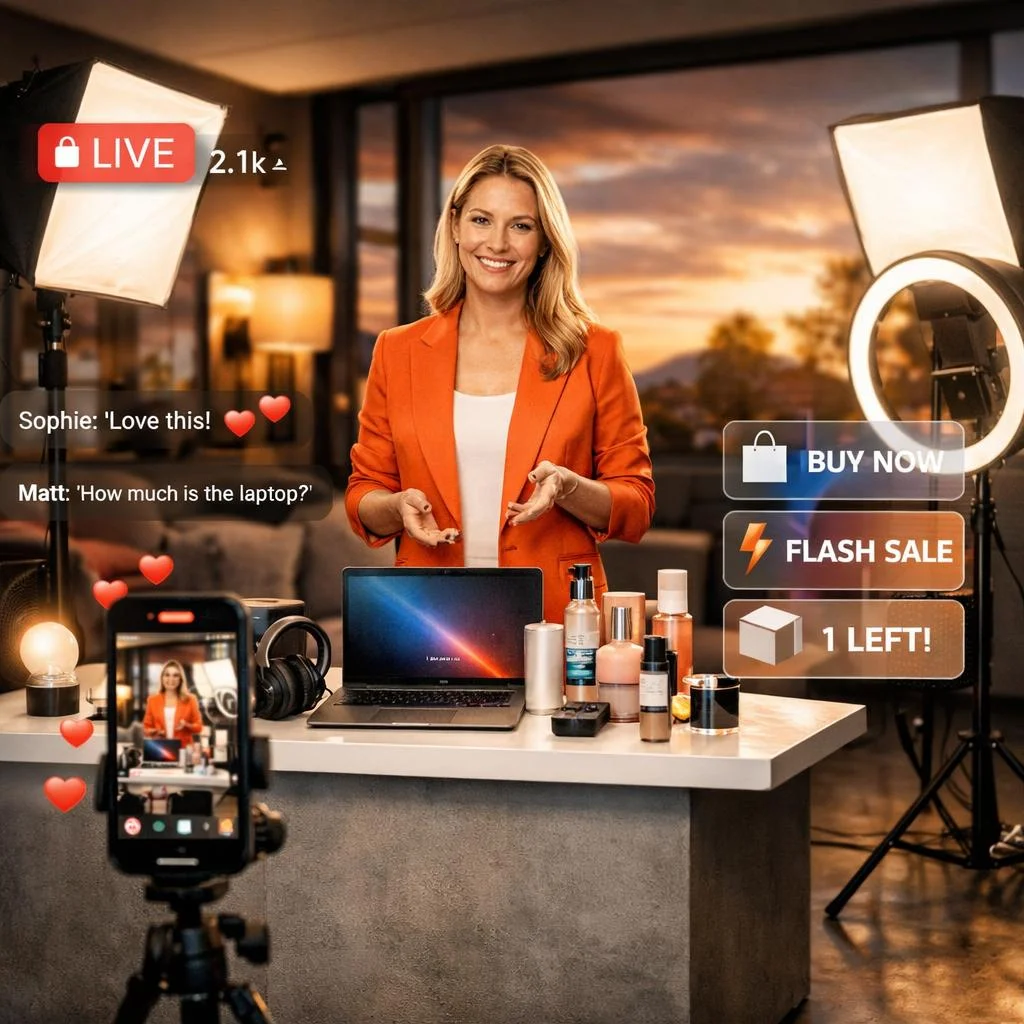
The Live Shopping Revolution: How Australian Brands Are Adapting to a New Retail Landscape
Retail has entered its most interactive era yet. Live social shopping is no longer an experimental tactic confined to overseas markets — it is rapidly becoming a core pillar of modern commerce. Global live shopping sales are projected to exceed $1 trillion by 2026, and the momentum shows no sign of slowing.
What began as a dominant force across Asia has evolved into a global retail strategy, with Australia now entering a critical adoption phase. At its essence, live shopping blends real-time video, influencer-led storytelling, and embedded purchasing into a single seamless experience. It transforms passive browsing into participatory commerce.
The scale of growth reflects more than novelty. The live commerce sector is projected to grow at a compound annual growth rate of 32% between 2024 and 2030, reaching an estimated $77.89 billion. This trajectory signals a structural shift in consumer behaviour rather than a short-term trend. Shoppers are seeking more than product listings and static images; they are looking for connection, clarity, and authenticity.
Platform Ecosystems Driving the Change
Platform ecosystems are accelerating this change. TikTok has emerged as a dominant force, particularly in the UK and Asia, embedding seamless checkout functionality within highly engaging short-form and live video content. Instagram continues to integrate shopping into Reels and Live features, while YouTube Shopping and Amazon Live are expanding creator-led commerce models.
These platforms are no longer simply awareness channels; they are fully operational retail environments. The distinction between content and commerce has effectively dissolved. A viewer watching a live demonstration is simultaneously a potential customer with a frictionless path to purchase.
Building Trust at Scale
What makes live shopping uniquely powerful is its ability to build trust at scale. Traditional product pages rely on polished imagery and written descriptions. Live commerce introduces two-way interaction. Customers can ask questions about compatibility, durability, performance, or suitability for their specific needs.
Demonstrations unfold in real time. Objections are handled live. That immediacy creates credibility and significantly reduces shopping cart abandonment. The format bridges the gap between the reassurance of in-store shopping and the convenience of digital commerce.
The Power of Scarcity and Urgency
Scarcity also plays a strategic role. Limited-time offers, exclusive live-only bundles, and countdown-driven incentives create urgency that mirrors the psychology of in-store promotions. The difference is that the audience is no longer limited by geography.
A well-executed live event can create nationwide demand within minutes, particularly when paired with influencer amplification. The combination of entertainment, exclusivity, and immediacy triggers purchasing behaviour that static product pages simply cannot replicate.
Demographics and Evolving Consumer Behaviour
The demographic implications are equally important. Younger consumers increasingly prefer short-form, video-first content over static browsing. They discover products through algorithms rather than search bars. In this environment, live shopping aligns naturally with evolving behaviour.
It blends entertainment with transaction in a format that feels native rather than intrusive. For brands targeting millennial and Gen Z audiences, live commerce is not an alternative strategy — it is becoming the primary strategy.
The Australian Opportunity
For Australian retailers and wholesalers, this shift presents both opportunity and responsibility. Live commerce is not confined to direct-to-consumer brands. It can be deployed to support independent retail partners, drive seasonal sell-in campaigns, launch new SKUs with immediate audience feedback, and educate customers in categories that benefit from demonstration.
Categories including hardware, electrical, cleaning, beauty, and seasonal products are particularly well-suited to the live format. Any product that benefits from visual demonstration, comparison, or expert guidance gains significant advantage in a live commerce environment.
From Campaign to Channel
The brands that will lead in 2026 are those that treat live shopping as an ongoing channel rather than a one-off campaign. Success requires consistency, storytelling capability, and integration between content, inventory, and fulfilment systems. It demands alignment between marketing and sales teams.
Most importantly, it requires a willingness to rethink what "retail presence" actually means in a digital-first world. Live shopping does not replace traditional retail; it enhances it. Physical stores still matter. Distribution still matters. Margin strategy still matters. But attention has become the new shelf space. And live commerce is proving to be one of the most effective ways to capture it.
The Transaction Begins Before the Checkout
The brands that embrace this model early will not simply see stronger conversion rates. They will build deeper relationships, gather richer consumer insights, and position themselves at the centre of a retail ecosystem that is increasingly interactive, immediate, and experience-driven.
In 2026, the transaction will not begin at the checkout page. It will begin the moment the camera goes live.
Ready to Explore Live Commerce?
At Webfx2 Digital, we help Australian brands develop content strategies that connect with audiences across every channel — including live and social commerce. Whether you're launching your first live event or building an ongoing live shopping programme, we can help you create experiences that convert.
Get in Touch