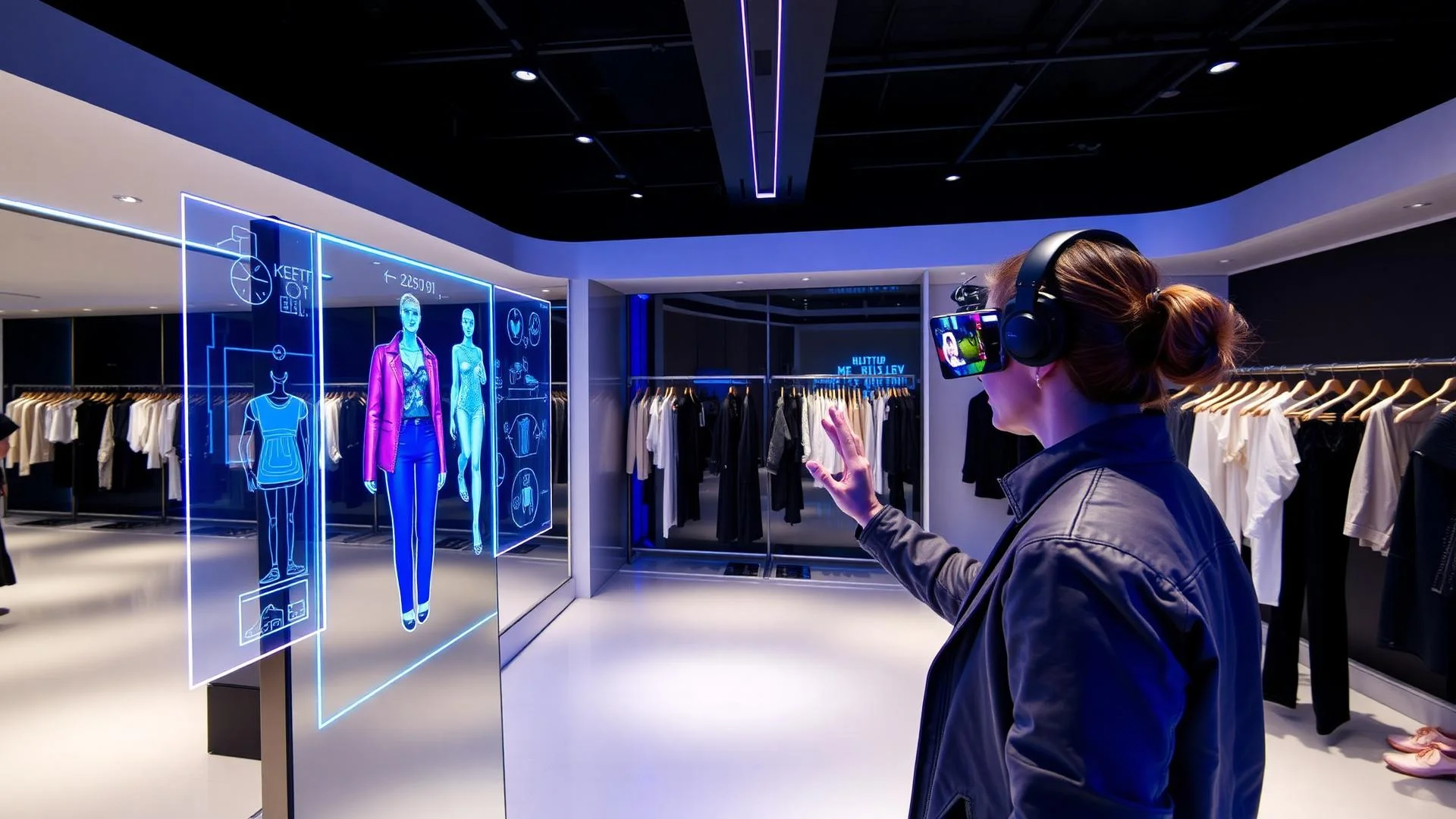
Virtual Try-On Tech Is Finally Catching Up to the Hype
Why AI-powered fitting tools are no longer a gimmick — and what that means for Australian retail
For years, virtual try-on technology sat in the "interesting but not quite there" category. Clunky overlays, poor lighting calibration, and awkward user interfaces meant most consumers tried it once, shrugged, and went back to guessing their size. That era is over. In 2026, AI-driven virtual fitting tools have matured to the point where they are actively reshaping purchase behaviour, return rates, and conversion metrics across fashion, beauty, eyewear, and homeware categories.
The Problem It Actually Solves
Returns are one of retail's most expensive problems. In online fashion alone, return rates routinely sit between 25 and 40 per cent. The primary reason? Fit uncertainty. Shoppers order multiple sizes with every intention of sending most of them back, and every returned item eats into margin, generates logistics overhead, and — in many cases — ends up in landfill rather than back on a shelf.
Virtual try-on addresses this at the decision point. Instead of hoping a garment will fit or a shade will match, consumers can see a reasonably accurate representation before they commit. It is not perfect — no technology replaces the tactile experience of fabric against skin — but it is now good enough to meaningfully shift buying confidence.
What Changed in the Last 18 Months
Three things converged to take virtual try-on from "demo reel" to "production-ready."
First, generative AI improved body and face mapping dramatically. Earlier systems relied on rigid 3D models and pre-set body types. Current implementations use diffusion-based models trained on millions of real-world images, which means they handle diverse body shapes, skin tones, and lighting conditions with far greater accuracy.
Second, mobile hardware caught up. The processing power required for real-time AR rendering was, until recently, limited to flagship devices. Mid-range smartphones now have the neural processing units (NPUs) and camera systems needed to run these experiences smoothly, which dramatically expands the addressable audience.
Third, integration got easier. A new generation of SaaS platforms has made it possible for mid-market retailers to deploy try-on features without building custom computer vision pipelines. What once required a dedicated engineering team can now be implemented as a widget or API integration within weeks.
Where It Works Best
Fashion and apparel remain the most obvious application, but the results are strongest in categories with high return rates and standardised products — think basics, workwear, and activewear rather than haute couture. When a shopper can confirm that a size 12 in a particular brand's cut will fit their frame, they are significantly less likely to order two sizes "just in case."
Beauty and cosmetics have arguably seen the fastest adoption. Virtual shade-matching for foundation, lipstick, and eyeshadow is now standard on most major beauty ecommerce platforms. The accuracy of colour rendering on modern screens has improved to the point where consumers trust the digital swatch almost as much as an in-store tester.
Eyewear is another strong category. Frame shape, size, and colour relative to face shape are highly visual decisions, and AR try-on tools handle them well because the product sits in a predictable position on the face.
Furniture and homeware use a different approach — spatial AR that places a 3D-rendered product in the consumer's actual room via their phone camera. This is particularly effective for high-consideration purchases like sofas, dining tables, and lighting fixtures where "will it actually fit?" is a genuine barrier to conversion.
The Conversion Lift Is Real
Beyond returns, virtual try-on is proving itself as a conversion tool. Industry benchmarks suggest that shoppers who engage with try-on features convert at rates 1.5 to 3 times higher than those who browse product images alone. The mechanic is straightforward: trying something on — even virtually — creates a sense of ownership. Once you have seen a jacket on your body, it stops being "a jacket" and becomes "my jacket." That psychological shift is powerful.
There is also a time-on-site effect. Consumers who interact with try-on tools spend longer on product pages, explore more products, and are more likely to add complementary items to their cart. For retailers optimising for average order value, these are meaningful levers.
What Australian Retailers Should Be Thinking About
Australia's ecommerce market has its own dynamics — a geographically dispersed population, high delivery costs relative to other markets, and a consumer base that values convenience but is also fiercely price-conscious. All of this makes the return problem particularly acute. A returned item in Australia often travels thousands of kilometres, making the logistics cost per return significantly higher than in more compact markets.
For Australian retailers, virtual try-on is not just a conversion optimisation tool. It is a margin protection strategy. Reducing returns by even 15 per cent can materially improve profitability, especially for brands shipping nationally from centralised fulfilment centres.
The opportunity is also in differentiation. Most mid-market Australian retailers have not yet deployed meaningful try-on experiences. Early movers have a window to position themselves as more innovative, more customer-centric, and more trustworthy than competitors still relying on static product photography and size charts.
The Limitations Worth Acknowledging
Virtual try-on is not a silver bullet. The technology still struggles with certain fabric types — sheer materials, heavy draping, and complex textures are difficult to render convincingly in real time. Colour accuracy, while improved, can vary depending on the consumer's screen calibration and ambient lighting. And for high-fashion or luxury purchases, the tactile and emotional experience of an in-store fitting room remains unmatched.
There are also privacy considerations. Body scanning and face mapping generate sensitive biometric data. Retailers deploying these tools need robust data handling practices, clear consent flows, and transparent privacy policies — particularly in markets like Australia where consumer data protection expectations are high and regulatory scrutiny is increasing.
Implementation: Start Narrow, Scale Smart
The retailers seeing the best results are not trying to deploy try-on across every product category simultaneously. They are starting with the categories where the return-to-conversion impact is clearest — typically their highest-volume, highest-return SKUs — and expanding from there based on data.
The integration approach matters too. The most successful implementations feel native to the shopping experience rather than bolted on. A "try it on" button that loads a clunky external app is friction. A seamless in-page experience that activates with a single tap is adoption. The difference between the two is often the difference between a feature that gets used and one that gets ignored.
Product photography also needs to evolve. Try-on tools work best when they have access to high-quality 3D product data or structured 2D imagery captured from multiple angles. Retailers still shooting flat-lay product photos will need to invest in more sophisticated content production to fully leverage these tools.
What Comes Next
The next wave of virtual try-on will likely move beyond individual products into styled outfits — AI systems that can dress you in a complete look, adjusting for your body type, colour preferences, and existing wardrobe. Some platforms are already experimenting with this, using generative AI to create personalised lookbooks that feel curated rather than algorithmic.
Social commerce integration is another frontier. As try-on features become embeddable in social media platforms, the path from "I saw it in a post" to "I tried it on and bought it" could compress to a matter of seconds. For brands investing in social-first commerce strategies, this is a development worth watching closely.
The Bottom Line
Virtual try-on has crossed the threshold from interesting experiment to genuine retail infrastructure. The technology is mature enough, accessible enough, and cost-effective enough for mid-market brands to deploy it meaningfully. For Australian retailers grappling with high return costs, geographic logistics challenges, and an increasingly competitive online landscape, it represents one of the clearest opportunities to improve both customer experience and commercial performance in 2026.
The brands that move early will not just reduce returns — they will build the kind of shopping experience that keeps customers coming back. And in a market where retention is the real growth lever, that matters more than any single conversion metric.